Why I Build Business Websites with Astro Instead of WordPress
Most small businesses are still on WordPress. I used to build with it too. Here's why I stopped, what I use now, and what my clients actually get out of it.
Walk into any small business in 2026 and ask who runs their website. Ten times out of ten, the answer is WordPress. Sometimes the owner knows that, sometimes they don't — they just know there's a monthly invoice for "site maintenance" and the homepage feels slow.
I built with WordPress for years. It pays the bills for a lot of agencies. But for the kind of work I take on now — five-to-twenty-page marketing sites for businesses that want to look serious online and get found on Google — I stopped reaching for it. Here's the thinking.
The problem with WordPress for small business sites in 2026
WordPress isn't broken. It powers a huge slice of the web for a reason: a non-technical owner can log in and change the homepage banner without calling a developer. That's a real superpower if you have a content team pushing daily posts, or a complex catalog with thousands of products.
The problem is that almost no small business site needs that. A scaffolding rental company doesn't update its pricing page on Tuesdays. A boutique importer doesn't run a daily editorial schedule. They want a clean, professional site that loads fast, ranks on Google, and doesn't break. And every month, with WordPress, you're paying for capabilities you don't use:
- Security maintenance. WordPress core and every plugin you install is an attack surface. Skip a few updates and you're a target. Most owners outsource this — and pay for it monthly.
- Plugin bloat. A typical small business site ends up with 15-30 plugins, half of which load on every page. Each one ships its own CSS and JavaScript, and they fight each other.
- Performance. Out of the box, WordPress assembles each page on demand by querying a database. That's slow. People paper over it with caching plugins, but caching is a workaround, not a fix.
- Hidden cost stack. Hosting that's actually fast, premium themes, premium plugins for forms or SEO or backups — you can easily clear $400 a year before you've sold anything.
None of this is WordPress's fault. It's a powerful tool being used to crack a walnut.
What is Astro? (in business-owner language)
Astro is a website framework. The thing that makes it different is when the work happens.
Think of WordPress like a restaurant that cooks every meal when you order. Customer walks in, kitchen fires up, plate arrives — slower, but flexible. Astro is more like a bakery that printed every page in the morning and stacks them by the door. When a visitor lands, the page is already there. No database call, no kitchen fire-up.
The technical version: Astro builds your site once, into plain HTML files. It ships zero JavaScript by default, only adding it where you actually need interactivity. The result is sites that score in the high 90s on Google's PageSpeed Insights without any tuning, and that don't require a database or a server constantly running in the background.
For a marketing site, that's the whole job. Be fast, be findable, look sharp, work everywhere.
My stack: Astro + Sanity + Tailwind
Astro on its own gets you a fast site, but I pair it with two more pieces:
- Sanity handles content. It's a small, clean editor where the client logs in and changes copy, swaps images, edits a price list — and Astro rebuilds the site automatically when they hit publish. The client gets the "I can edit my own site" benefit of WordPress, without WordPress.
- Tailwind is how I build the design. It lets me hit pixel-perfect layouts on phones, tablets, and desktops without dragging in a heavyweight theme. Every site ends up consistent, responsive, and styled exactly the way the brand needs.
Astro is the glue. Sanity holds the words. Tailwind paints the picture. The owner gets a site that loads instantly, they can edit themselves, and that doesn't need a team to keep alive.
Real results from real client sites
Two recent projects, both live, both serving Israeli small businesses. The numbers below are mobile PageSpeed Insights scores — the test Google itself uses to evaluate a site's Core Web Vitals.
AVQB — importer of Voltronic and Winmaxx products
AVQB needed a clean catalog and brand site that made them look credible to wholesalers. Built on Astro:
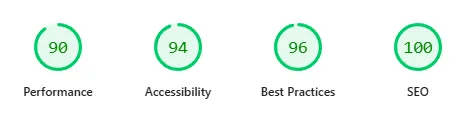
A 100/100 SEO score and 90 on mobile performance is something most WordPress sites need a dedicated optimization pass — and a paid plugin or two — just to approach.
Pigum Yashir — mobile scaffolding rental
A service business that lives or dies on local search visibility. The redesigned site went live with Google Ads conversion tracking wired in from day one and generated its first qualified lead within 24 hours.
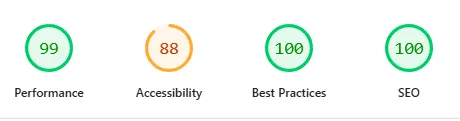
A 99 on mobile performance puts the site in roughly the top 1% of pages Google measures. For a business whose customers are calling from the side of the road on a phone, that's not vanity — that's whether the page loads before they bounce to a competitor.
For comparison: typical WordPress small business sites I've audited score between 35 and 60 on mobile performance, with first contentful paint somewhere between 3 and 6 seconds. The Astro sites above land in well under 1.5 seconds, on the same hardware, on the same networks.
When you shouldn't switch to Astro
I'd be lying if I said Astro is right for everyone. A few cases where I tell prospects to stay on WordPress (or Shopify, or Webflow, depending on the situation):
- Heavy e-commerce. If you need WooCommerce with 10,000 SKUs, complex variant pricing, and a stream of inventory updates, the WordPress ecosystem is genuinely hard to beat on a budget.
- Daily editorial workflow. A team of 20 editors pushing content, with revision history and editorial roles? WordPress was built for that exact shape of org.
- Plugin-dependent business logic. If your booking system, your membership site, and your forum are all WordPress plugins gluing into each other, ripping that out is a re-platform, not a redesign. Astro isn't the right cost answer there.
The honest test: how often does your content change, and how complex is the back-end logic? If the answer is "a few times a month" and "not very" — which is most small businesses I talk to — Astro will give you a faster, cheaper, safer site. If the answer is "constantly" and "heavily" — keep what's working.
If your WordPress site is slow and costing you monthly
If you're a business owner paying every month for WordPress maintenance, your site still loads slowly, and you suspect you're overpaying for a setup you don't need — let's talk. I build fast, secure, low-maintenance websites for small businesses, and most of my clients come to me from exactly that situation.
You can see a deeper case study of recent work or browse the service packages. Or scroll down and message me directly.